
You meet someone for the first time.
They’re late.
Your mind begins filling in the blanks.
Disorganized.
Don’t respect my time.
Probably always like this.
Later, you learn there was an accident on the highway.
Same person.
New information.
Different story.
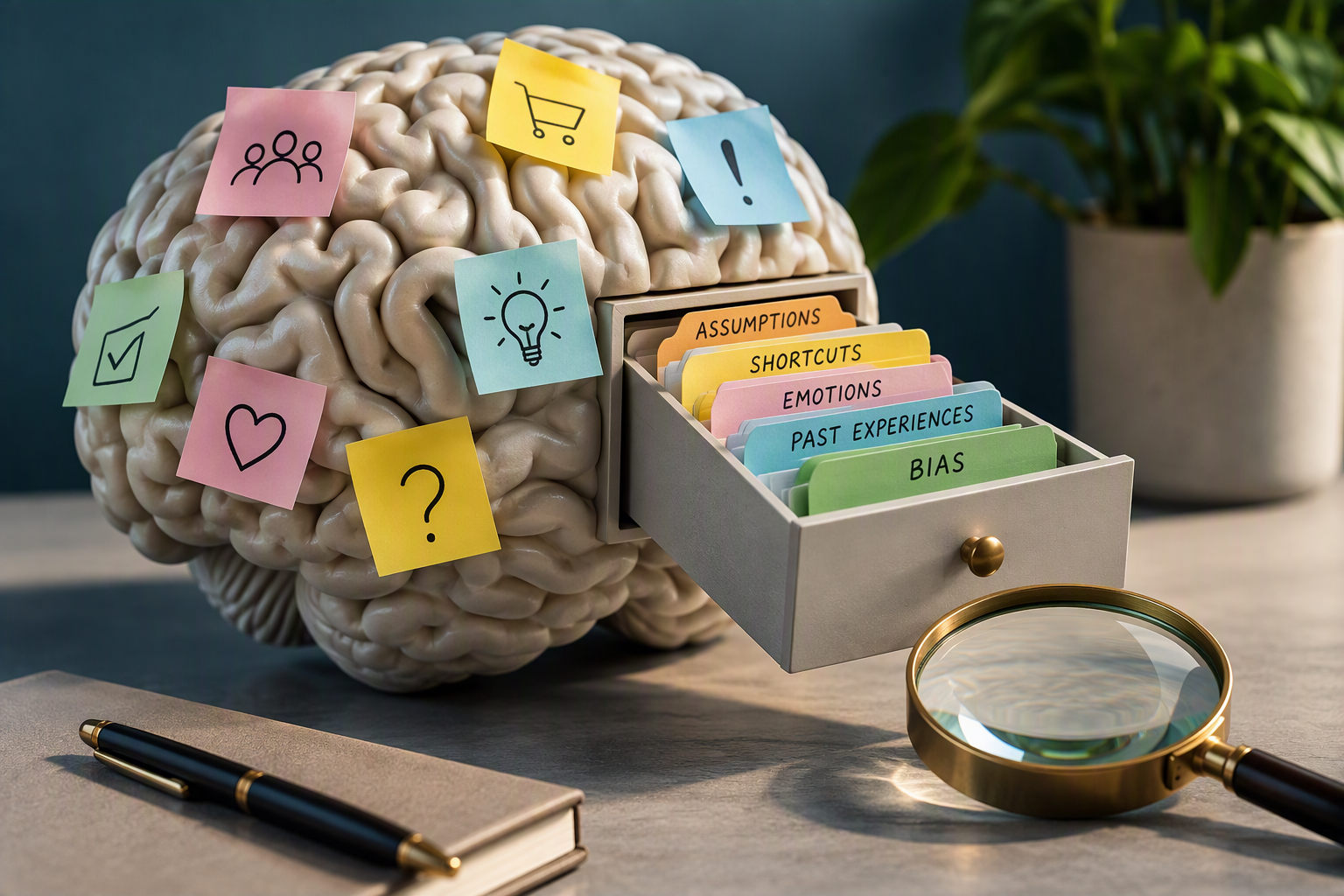
Our brains are constantly making sense of incomplete information. Mental shortcuts help us process a complicated world efficiently, but those shortcuts can also introduce predictable errors in judgment.
We rarely experience that process as bias.
It usually feels like being right.
A Few Worth Recognizing
Confirmation bias
You already believe something, so information supporting it gets your attention.
The contradictory evidence?
Much easier to question.
Anchoring
The first number or idea establishes a reference point.
A $40,000 price can feel inexpensive after someone first says $50,000, even though neither number tells you what something is worth.
Bandwagon effect
Everyone seems to believe it.
That starts becoming evidence all by itself.
We’ve already explored independent thinking elsewhere on this site, and this is one reason it matters.
Fundamental attribution error
Someone cuts you off in traffic and you decide they’re inconsiderate.
When you make the same maneuver, you have a reason.
Context tends to be more available for our own behavior than someone else’s.
Outcome bias
A bad decision can produce a good result.
A good decision can produce a bad one.
Judging the quality of the decision only after seeing the outcome can teach us the wrong lesson.
Bias Isn’t Something Other People Have
That’s the part I find most useful.
Cognitive bias isn’t a flaw reserved for people who aren’t thoughtful enough. These mental shortcuts are part of ordinary human information processing.
Awareness doesn’t make us immune.
It does give us a reason to pause when the stakes matter.
Before making an important judgment, try adding a little resistance to your first conclusion:
What evidence would make me reconsider this?
What context might I be missing?
Am I evaluating the decision or reacting to the outcome?
Would I judge this the same way if a different person had done it?
You don’t need bias names memorized before your next decision.
You may just need enough humility to remember:
Your first explanation isn’t the only one available.
And sometimes the smartest thing we can do with a confident conclusion is give it a second look.


Leave a Reply